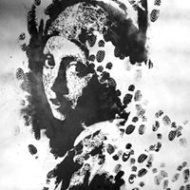
Want to put your creations in a flash on any kind of support, without struggling with the classic methods?
Welcome to the Slaff adventure!
What is Slaff Paper?
It is the paper necessary for the practice of Slaff, an innovative method designed by R.Nuage, designed to allow an ultra-fast transfer of your visuals painted with bomb or stencil, drawn to markers or pen on any kind of surface. A quick and bluffing method to show your works even in the most frequented places.
How to apply the Slaff Paper already painted?
- Choose a surface to embellish (“metal furniture is my favorite surface”)
- “Cleans” the chosen surface (“a simple rag is enough to remove the largest from the dust”)
- Spray of the transparent permanent glue, on the chosen surface (“I use at the moment a strong spray glue with professional quick setting 3M77, I used before the 3M90 which works very well too…” )
- Marouflage the Slaff on the fresh glue, over the holding paper (“I tried several tools to marouflage, the hand is finally the ideal”)
- Detach only the holding paper (“the Slaff must remain on the chosen surface. I advise to have previously separated a corner of Slaff from his holding paper before laying to facilitate this step.”)
- Spraying water generously on the Slaff (“the Slaff Paper disappears in seconds. If we rub then that your work is not yet fixed, the painting is torn off, disintegrates…).
- Take a picture of the result now that there is only the paint left on the embellished surface (“If the result suits you, do not hesitate to post it on social networks with the keywords @Slaff_Pape r #SlaffPaper to invite us to relay”)
Demo vidéo
How to use the Slaff Paper to customize?
- Cut a piece of Slaff Paper to the dimensions of your choice
- Lays it and holds it flat on a work surface (“I use repositionable glue or masking strip so that it does not move and does not roll on itself”)
- Pains tone visual on the Slaff Paper, with a bomb or a marker (
 avoids any water-based paint).
➤ Important: as you work backwards, think of reversing the texts (mirror effect) and if you are a stencilist, also think of putting your colors in reverse order.
(Example: instead of making Grey then Black then White, do instead White then Black then Grey) - Allow the paint to dry properly before storing your creation or transfer it.
➤ You can keep it several weeks away from moisture, waiting to find the perfect spot
Slaff Paper Personalization Demo Video
Which paint to use on the Slaff Paper?
Promote proven techniques:
✅ standard spray bomb (MTN, Montana, Flame, Molotow, …)
✅standard spray paint diluted with white spirit applied with brush or knife
✅ permanent marker for CD
✅ ballpoint pen (Bic crystal)
✅ indelible marker for TAG type Molotow
✅ ink silkscreen printing plastisol
Do not use paints/techniques using water as a diluent:
❌ watercolor, acrylic, spray bomb water base, classic screen printing ink, inkjet printer, etc…
Which glue to use to transfer your Slaff?
Glue is a very important element for the success of the transfer of its Slaff. We recommend the use of a transparent strong glue with a quick set.
The test artists and the Slaff Paper team currently advises:
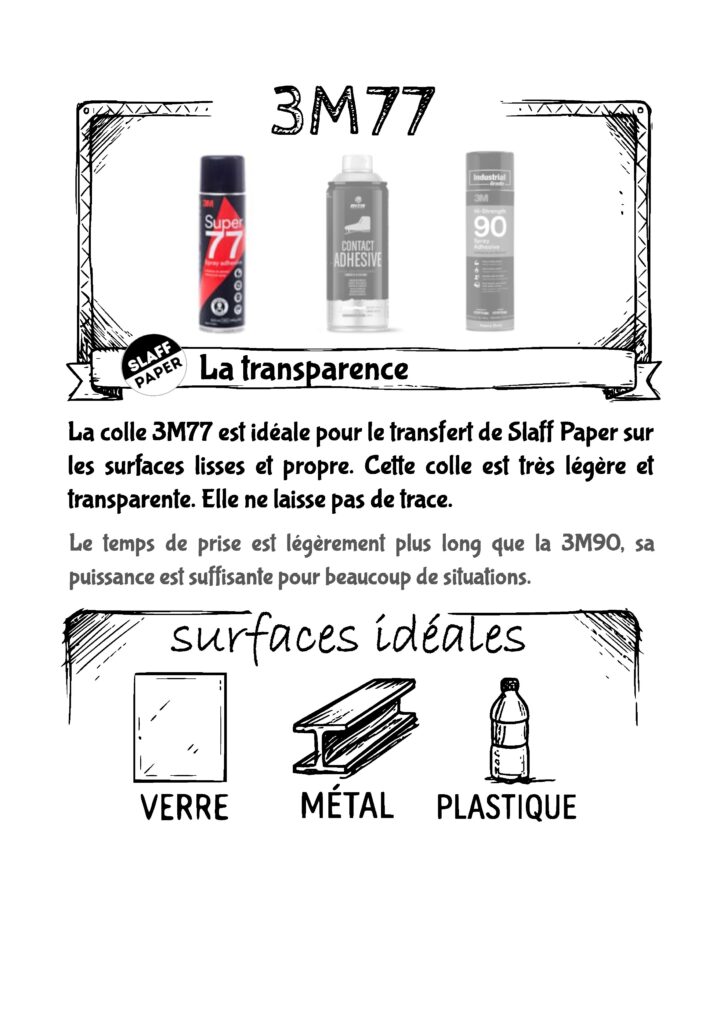
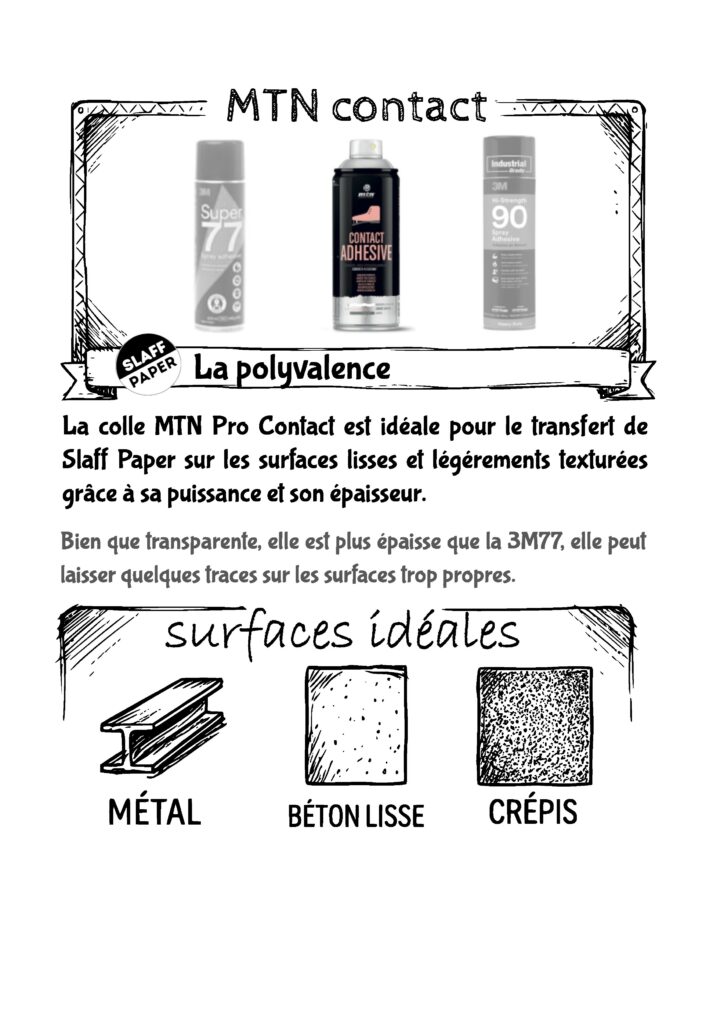
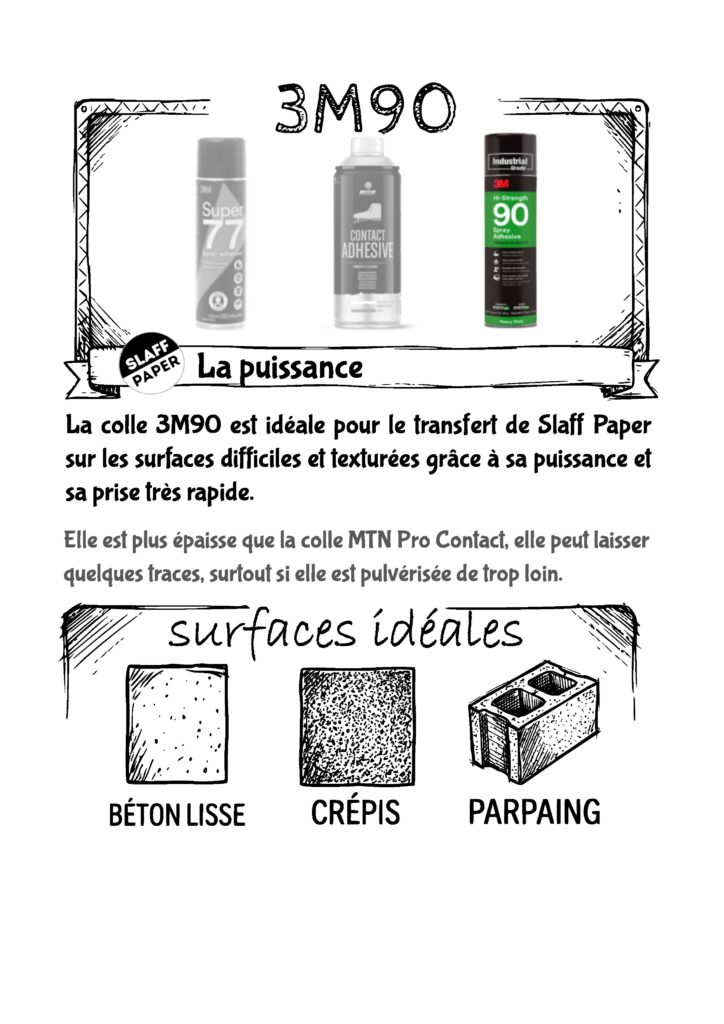
✅ glue spray 3M77 ; MTN Contact ; 3M90 ; If you rub the wet Slaff before the glue is fixed enough, the paint will also disintegrate. Watering and caressing the edges is enough, there is no need to rub hard on all the visual…
- 3M77 : ideal for smooth surfaces, it is very light and transparent, it leaves no trace. The setting time is slightly longer than the 3M90 and its power is sufficient. To choose for metal surfaces, plastics, glasses, smooth concrete. I replace the original nozzle with a fatcap decapfour for an even more transparent broadcast!
- MTN Pro Contact: ideal for smooth and textured surfaces thanks to its power and thickness. Although transparent, it is thicker than the 3M77, so it can leave some traces on surfaces too clean. I replace the original nozzle with a Big Shotty Ultra cap that I clean at the MTN dissolving for a broadcast that leaves less trace.
- 3M90 : ideal for rough and very textured surfaces, it is a little thick and can leave traces if sprayed too far from the surface. Its thickness is actually an asset for very difficult surfaces, its grip time is really fast and it is very powerful. To choose for surfaces type: coating, plaster, parpaing.
What did not work sufficiently:
❌ Varnish glue, repositionable glue, permanent glue Rougier&Plé
If the glue does not dry fast enough or is not powerful enough, the transfer does not work properly and causes some disappointments.
How to separate the Slaff from its holding paper?
It is essential to make a start of take-off of support paper before an urban intervention if you do not want to struggle and lose precious time with this step once the Slaff has stuck on his spot…
Method 1: Rub with a wet finger :
Method 2: Stick a piece of masking tape and then take off like a sticker.
Slaff definition, vocabulary
The Slaff is a street-art technique that complements the existing palette (Graff, Stencil, Collage…)
The word Slaff is a fusion of the onomatopoeia Spla tch (the sound of the water that hits the wall) and the word gr aff (the bomb street paint).
The Slaff or slaffer is the action of applying paint, in a few seconds, to a wall, by projecting water onto Slaff Paper.
The Slaff Paper is the transfer paper necessary for the practice of Slaff.
The practice of this extremely fast urban painting technique is called Slaffing. [Method invented in 2024 by the street artist R.Nuage (see section of the Slaff)].
What equipment is recommended to make Slaff?
- Slaff Paper ® (Shop Slaff Paper)
- Transparent strong permanent glue (type 3M77)
- Paint in bomb
- A water spray
- A rag
- Gloves not to damage your hands and a mask to protect against the vapors of glues
What are the advantages of Slaff over other street-art techniques?
Thanks to the Slaff, it is possible to lay extremely sophisticated paintings in the busiest streets. The artist can take all his time in the studio to realize detailed paintings, in various colors, without depriving himself of effects of transparency, to then need only a few seconds to lay this work in urban condition.
Bonus: The artist can even send, by mail, his work on Slaff Paper to a · e friend and distant· e to delegate the transfer of his embellishment to another country, another city… it smells of the Slaff Paper Invader …
Comparison of the most common street-art painting techniques (Collage vs Stencil vs Slaff vs Graff):
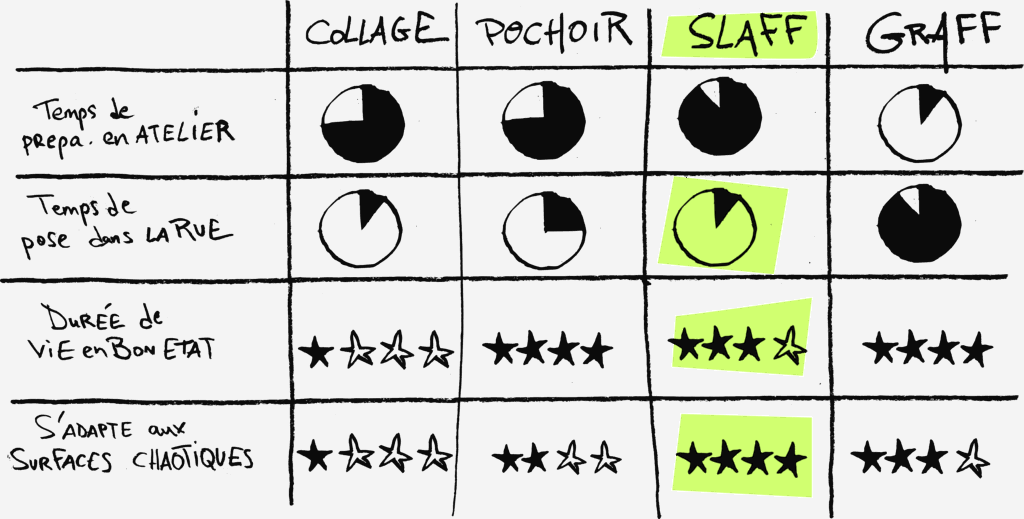
Conclusion, the Slaff combines the speed of installation of a collage and the visual quality of the graffiti or stencil:
- the Slaff makes it possible to have a graphic rendering similar to the technique of graffiti and stencil (radiant colors, vaporization effects, effects of transparencies effect of molten with the support, absence of “opaque edge in white paper”).
- the installation of a work in urban condition, prepared on Slaff Paper, is as fast as a collage but the work can not be torn …
The Slaff lasts a long time?
The lifespan of the Slaff depends on the conditions of exposures as well as other urban intervention techniques. An indoor Slaff, not exposed to UV or weather, does not move. A Slaff exposed in full touch of water or in full sun will age. The power of the glue used and the conditions of the installation also have influence. A glue too little powerful or a Slaff transferred on a very dusty surface or on a very humid surface will not resist for long because in both cases the glue will not have allowed a good fixation of the paint.
This technique is very recent, the oldest Slaff still visible to soon a year…
History of Slaff
Painting in the street is really cool, but sometimes it’s a little risky. The workshop is ideal for developing detailed painting. The technique of urban collage is an interesting method to bring the world closer to painting in the studio and the contact with the public of urban space. But its fragility at tears and its opaque rendering is sometimes embarrassing. I searched for years for alternatives to avoid the disadvantages of collage (see the adoptable project pages) but I was still far from my expectations.
When one day, in the kitchen, an error of ingredient opened the way… The artist Astrid & Al, wishing to help me prepare a meal, brings back rice leaf instead of the brick leaf provided by the recipe. I then discover – by serendipity – that the leaf of rigid and slightly opaque rice becomes completely transparent and slightly sticky in contact with water. That’s how Slaff Paper’s first essay was born, painting on a dry rice leaf and discovering the behavior of the paint once it’s watered abundantly.
After many essays, then some promising progress, the artists duo Canned came to participate in the many experiments with various ingredients, varnishes, glues, paints, materials and methods of application.
Once the technique was sufficiently stabilized in the studio, it is with the artist K.Yo that many essays, in real conditions took place in the streets of Paris 13. We managed to lay 5 paintings in less than 45 minutes before running on public transport so we wouldn’t miss our train.”
Archive Video
- 012-2024 : various projects, including painting on the back of the plexiglass 2024 : Invention and proof of concept 2025 : Slaff Paper Version 1.0 [prototype for pioneer] (out of stock version) 2026 : Slaff Paper Version 2.0_beta [pre-industrial version] (final phase development – user tests)
Pioneers of the Slaff movement
- R.Nuage : https://www.instagram.com/r.nuage/
- Astrid&Al. : https://www.instagram.com/astri_d_al/
- Duo Canned : https://www.instagram.com/canned.artist.duo/
- K.Yo : https://www.instagram.com/julien_k.yo/
- Ɛsca- SK : https://www.instagram.com/esca_mtp/
- Lilielalune : https://www.instagram.com/lilielalune/
- Sori : https://www.instagram.com/sori_artiste/
- ….
- … seras-tu le prochain ?
Legal mention
Slaff Paper® is a trademark registered under the code INPI: 5152100 FR
The textual content on this page has been written and licensed by R.Nuage